Fresh corn is on the stove for a summer cookout, but the kernels can turn chewy before the burgers are ready. How do you know when to pull the cobs from the pot?
At a weeknight dinner, the corn looks ready beside the grilled chicken, but the first bite is disappointingly soft. Following the same routine every time can fall short when one potful cooks differently from the last. A small adjustment can make tender kernels easier to achieve without leaving dinner to guesswork.
Fresh corn needs about 3 to 5 minutes in boiling water
Boil shucked corn on the cob for about 3 to 5 minutes for bright yellow, crisp-tender kernels. That short cooking time warms and softens fresh corn without leaving it overly soft. There is no single minute count that fits every ear: some recipes use 2 to 4 minutes, while others call for 5 to 7 minutes.
Start checking at 3 minutes rather than waiting for a timer alone to decide. Ear size, the amount of water in the pot, and whether the corn goes into boiling or cold water all affect how long it takes to cook.
Too much time in the pot makes corn soft
Heat softens the kernels, which is why a brief boil gives fresh corn its tender bite. A long boil keeps softening them; cooking for 20 minutes can leave corn too soft. More time is not a reliable fix for corn that was already less tender when purchased.
Salt is a matter of preference, not a necessary step. Some boiling recipes call for salted water, while others caution that it can toughen kernels. Plain water avoids that concern, and salt can be added at the table.
A roomy pot helps the ears cook evenly
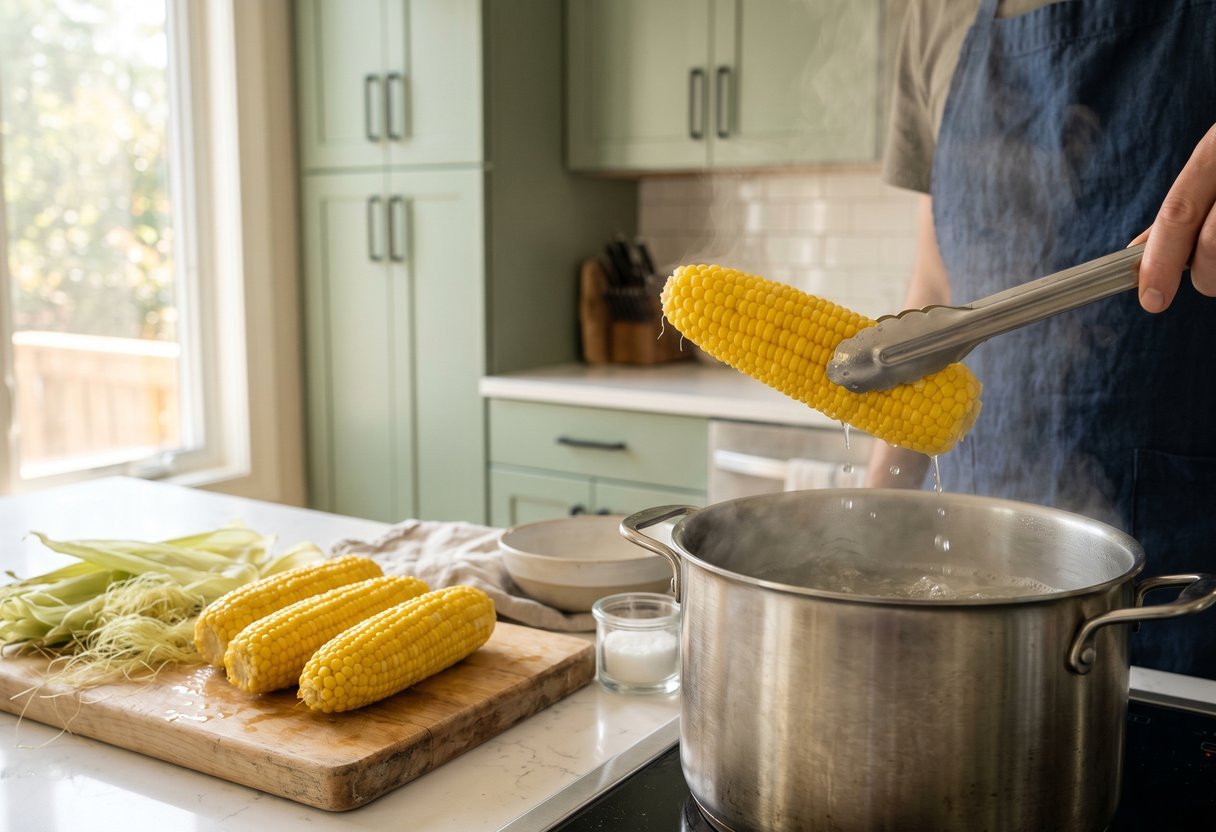
Remove the husks and silk, then rinse away any remaining silk under cool water. Fill a large pot with enough plain water to submerge the ears and bring it to a rolling boil. Add no more than about 4 ears at a time if that is what fits comfortably; crowding makes even cooking harder.
Lower the corn into the boiling water with tongs. Once the water returns to a boil or steady simmer, cook for 3 minutes, then lift out an ear and test a kernel with a fork. Continue cooking and checking for up to 5 minutes for crisp-tender corn; a thicker ear may need up to 7 minutes. Remove the ears as soon as the kernels are tender but still firm, rather than leaving them in the hot water.
Milk and butter are optional, not part of the timing
Some Southern-style recipes add milk, butter and sugar to the cooking water for a richer flavor. Those additions do not replace checking the kernels for tenderness. For a dairy-free meal, use plain water and add a preferred topping after cooking; plain corn also leaves room for seasonings such as lime or chili powder.
Freshness and prompt storage matter
Sweet corn is most available in mid-summer. Fresh ears are a good starting point for the short boiling times above, but out-of-season corn should still be checked by texture rather than given an automatic extra few minutes.
Refrigerate leftover cooked corn promptly at 40°F (4°C) or below. To warm it later, wrap each ear tightly in foil and heat in a 350°F (177°C) oven for 5 to 7 minutes. For the next pot, keep the ears uncrowded and test one early: a firm, tender kernel is a better guide than a fixed timer.