You buy bananas for the week, but they’re green when you need one and spotted when you don’t. Could a small change in your kitchen routine make their timing less frustrating?
The banana set aside for tomorrow’s oatmeal has soft brown spots by breakfast. Leaving the bunch on the counter offers little control over how quickly it ripens. A small change in how the fruit is stored can shift the timing, but the right choice depends on when it will be eaten.
A paper bag speeds ripening, while a hook helps slow it
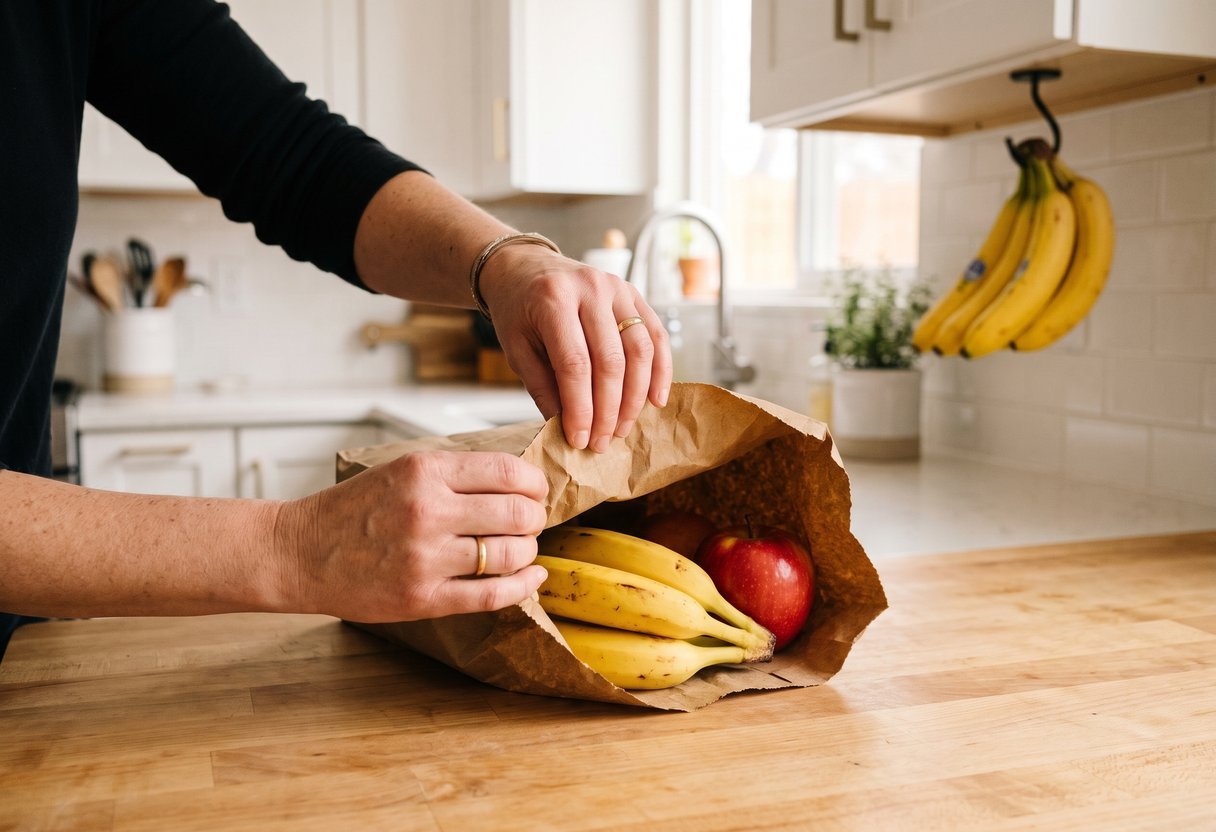
To ripen bananas faster, put them in a paper bag with an apple and fold the top closed. The bag holds in ethylene, a gas the fruit naturally releases that triggers ripening; the apple adds more. To help bananas last longer on the counter, hang the whole bunch from a hook so the fruit is less likely to bruise against a bowl or countertop.
These methods manage different parts of the ripening process. A bag concentrates ethylene around the bananas, while a hook reduces contact and damage that can hasten ripening. Neither method stops ripening, and the starting ripeness of the bananas matters.
Ethylene changes bananas as they ripen
Ethylene is a natural, colorless, odorless plant hormone. As bananas ripen, their color, sweetness and texture change. Bananas give off ethylene themselves, so an apple is optional, but apples are high ethylene producers and can help move the process along.
A paper bag is useful because it holds some of that gas near the fruit without creating an airtight enclosure. McIntosh apples are especially high ethylene producers, but a different apple can also be used. There is no reliable at-home timetable for how much faster any particular apple will ripen a particular bunch.
Check bagged bananas daily
Place 1 bunch of bananas in 1 paper bag, add 1 apple if faster ripening is needed, then fold the top closed. Leave the bag at room temperature and check the bananas every 24 hours. Take them out when they reach the color and softness needed for eating or cooking, rather than leaving them in the bag for a fixed number of days.
Keep the bag out of direct sunlight and away from excessive heat, which can make ripening uneven or encourage spoilage. Do not substitute a tightly sealed plastic bag: trapped moisture can favor mold or rot. If a banana develops visible mold or an off smell, discard it rather than trying to ripen it further.
Hanging the bunch is different from separating it
For slower countertop ripening, hang an intact bunch on a banana hook where air can circulate around it. Suspending the fruit reduces the contact points where it could be bruised. Without a hook, an open rack can help keep the bunch off a hard countertop, though it may not prevent as much contact.
Pulling every banana apart is a separate claim, not a necessary step in the hook method. Chiquita recommends separation, reasoning that an intact bunch produces more ethylene, but a small kitchen comparison found no slower ripening in separated bananas. In 2 repeated trials, the separated bananas ripened faster; the number of bananas tested was not provided, so that result cannot predict every bunch.
Choose the paper bag when bananas are needed soon. When there is no rush, leave the bunch hanging and check it each day for the ripeness needed.