You cut into an avocado for Tuesday’s lunch, then find the other half brown by dinner. We tried six common storage approaches to see whether any could keep the leftovers appealing through the week.
On Sunday, 3 avocados on the counter feel ripe, but lunch calls for only 1. Refrigeration can buy time for whole avocados, yet it does not reliably keep a cut surface green. Some popular storage ideas also raise food-safety concerns, so appearance is not the only measure that matters. A simple change in how the leftover half is stored made a difference, though even that approach has limits.
Onion helps cut avocado stay green
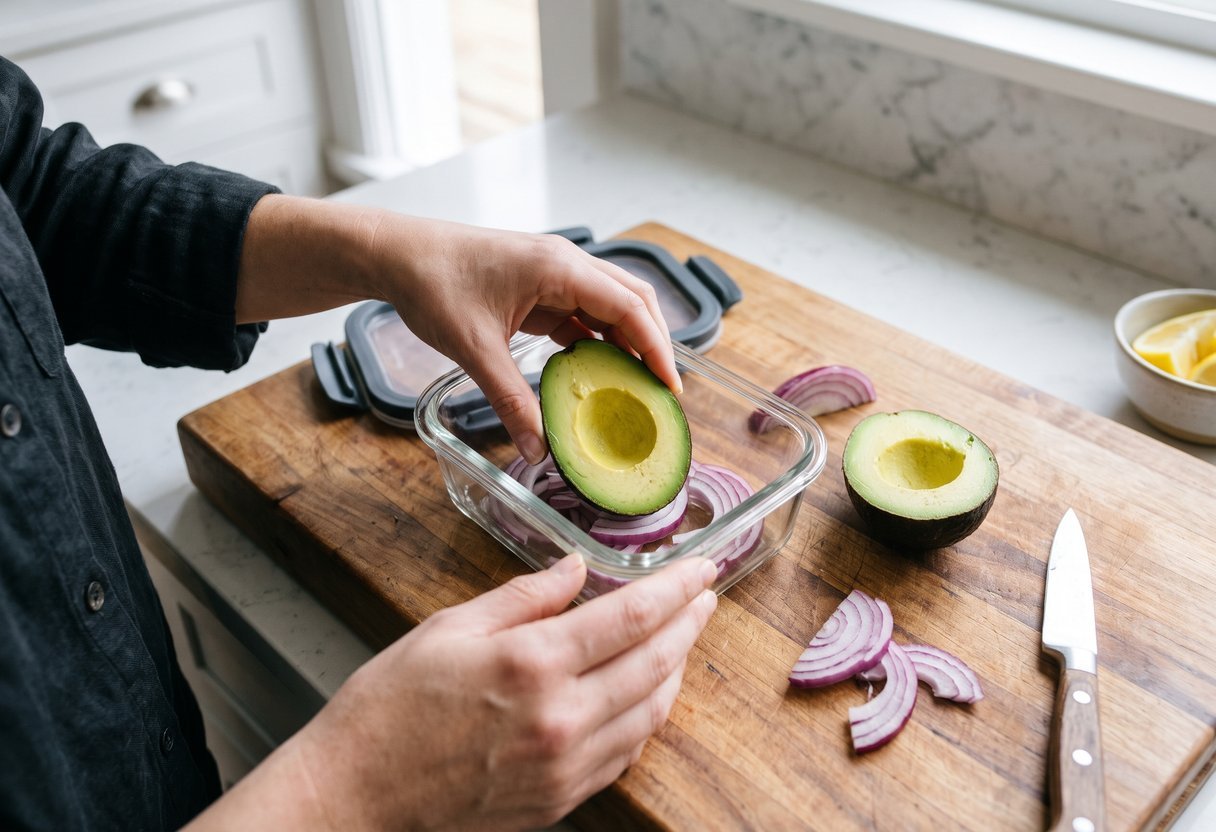
Store a cut avocado with sliced onion in an airtight container to slow browning. Compounds released by the cut onion inhibit the enzyme reaction that darkens avocado flesh. This is a way to preserve its color, not a way to make it safe to keep indefinitely.
For 1 avocado half, place a few onion slices in an airtight container, set the avocado cut-side down beside them, close the lid, and refrigerate promptly at 40°F (4°C) or colder. In 1 home storage test, cut avocado kept this way stayed green for up to 5 days. That result describes color, not a guaranteed safe storage time; for best freshness, plan to eat a cut half within 1 to 2 days.
Air exposure turns avocado flesh brown
Once an avocado is cut, enzymes in its flesh react with oxygen in the air. The surface can darken quickly even when the rest of the fruit still looks appealing. Keeping the cut face covered and cold slows the change, but neither step prevents it completely.
Green color alone is not proof that an avocado is safe to eat. An onion may help with browning, but it does not remove bacteria that could be present on the fruit or introduced while cutting it.
Water can hide browning without making storage safe
Submerging a cut avocado in water limits its contact with air, which helps explain why the method can keep the surface green. The FDA does not recommend it because bacteria on the skin can contaminate the water and reach the flesh. In FDA sampling, Listeria monocytogenes was found on 17.73% of 1,615 avocado skins tested; Salmonella was found on 12 skin samples from domestically grown avocados.
FDA scientists also found that Listeria could enter avocado pulp during refrigerated water storage within 15 days. That finding does not establish a safe shorter soaking time, and washing the skin afterward would not remove bacteria already inside. Use a covered container without water instead.
Lemon juice and tight wrapping offer another option
For a cut half that will be eaten soon, brush the exposed flesh with lemon juice, press plastic wrap tightly against the surface, and refrigerate it promptly. Lemon juice slows browning, while the wrap reduces contact with air. In a small side-by-side home comparison of 5 methods, this combination kept the flesh greener than the other methods tested; a home test cannot guarantee the same result for every avocado.
Wash the avocado skin before cutting so the knife is less likely to carry contamination into the flesh. Leave a firm, unripe avocado at room temperature, where it typically ripens in 4 to 5 days, then refrigerate it whole once ripe for about 3 days. Cut only what is needed, and use the remainder within 1 to 2 days when possible.