You find an old jar at the back of your pantry and pause before adding its contents to your tea. Does its age mean it belongs in the trash, or is there a surprising reason to keep it?
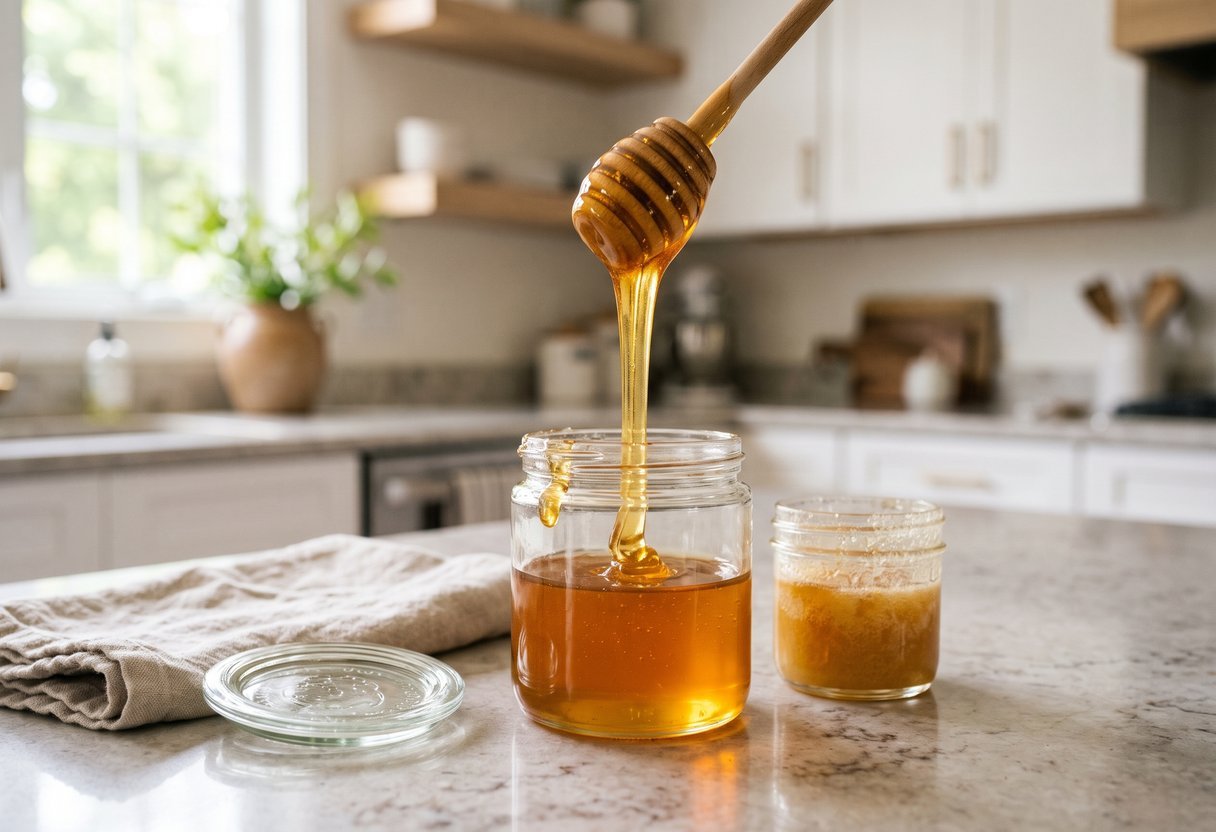
Breakfast is ready, but the spoon comes out of the jar with a pale, grainy scoop instead of a smooth drizzle. Throwing it out because it looks different may be premature, but appearance alone cannot settle the question. A small detail about how the jar was kept matters more than it might seem.
Properly stored honey resists spoilage
Pure honey kept tightly sealed at room temperature can remain edible for years because its low moisture and natural acidity make it difficult for spoilage organisms to grow. That is what the claim that honey “never goes bad” means in a pantry: it depends on keeping water out. Accounts of honey found unspoiled in Egyptian tombs sealed for more than 3,000 years illustrate its unusual staying power, but an opened kitchen jar still needs a secure lid.
Bees make honey difficult for microbes to use
Honey typically contains about 17% to 18% water. Its sugars bind much of that water, leaving too little available for most bacteria and fungi to grow. Honey also draws moisture from its surroundings, including microbial cells, which helps explain why it resists spoilage and why it should not be left uncovered in a humid kitchen.
Honey’s pH is generally about 3.2 to 4.5. That acidity adds another barrier to the growth of many spoilage organisms, though acidity alone does not make a food sterile. Bees help create the low-moisture conditions by fanning nectar to evaporate water, then sealing finished honey in the comb with wax.
Bees also add an enzyme called glucose oxidase. When honey is diluted, the enzyme can produce hydrogen peroxide, which has an antimicrobial effect. It is an added part of honey’s antimicrobial properties, not a reason to treat honey as a disinfectant or a medical treatment.
Crystals are normal, but fermentation is not
A grainy, thick, or partly solid jar has usually crystallized rather than spoiled. Glucose separates from the liquid over time, changing the texture without making the honey unsafe. Crystallized honey can be used as it is; for a liquid texture, a sealed jar can be placed in a bowl of warm water until the crystals dissolve. Keep water out of the jar and avoid microwaving, which can degrade honey’s natural enzymes.
Water contamination is different. A wet spoon or an unsealed container can raise honey’s moisture enough for yeast to ferment its sugars, particularly when the water content rises above roughly 18% to 20%. Honey that smells off or tastes sour should be discarded rather than warmed or stirred back into use.
A tight lid protects the jar, not infants
Keep honey tightly sealed in a glass container at room temperature, away from direct sunlight and heat. Refrigeration is not needed to preserve it and can encourage faster crystallization. Use a clean, dry spoon each time so the low-moisture conditions that protect the honey stay intact.
Long shelf life does not mean honey is safe for everyone. Honey can contain spores that cause infant botulism, so children younger than 12 months should not be given honey or honey products. For the rest of the household, the useful pantry habit is simple: close the lid promptly and keep wet utensils out.