Your Thanksgiving menu may look familiar every year, but an older relative might remember a very different spread. Which once-familiar dishes have quietly disappeared from American holiday tables?
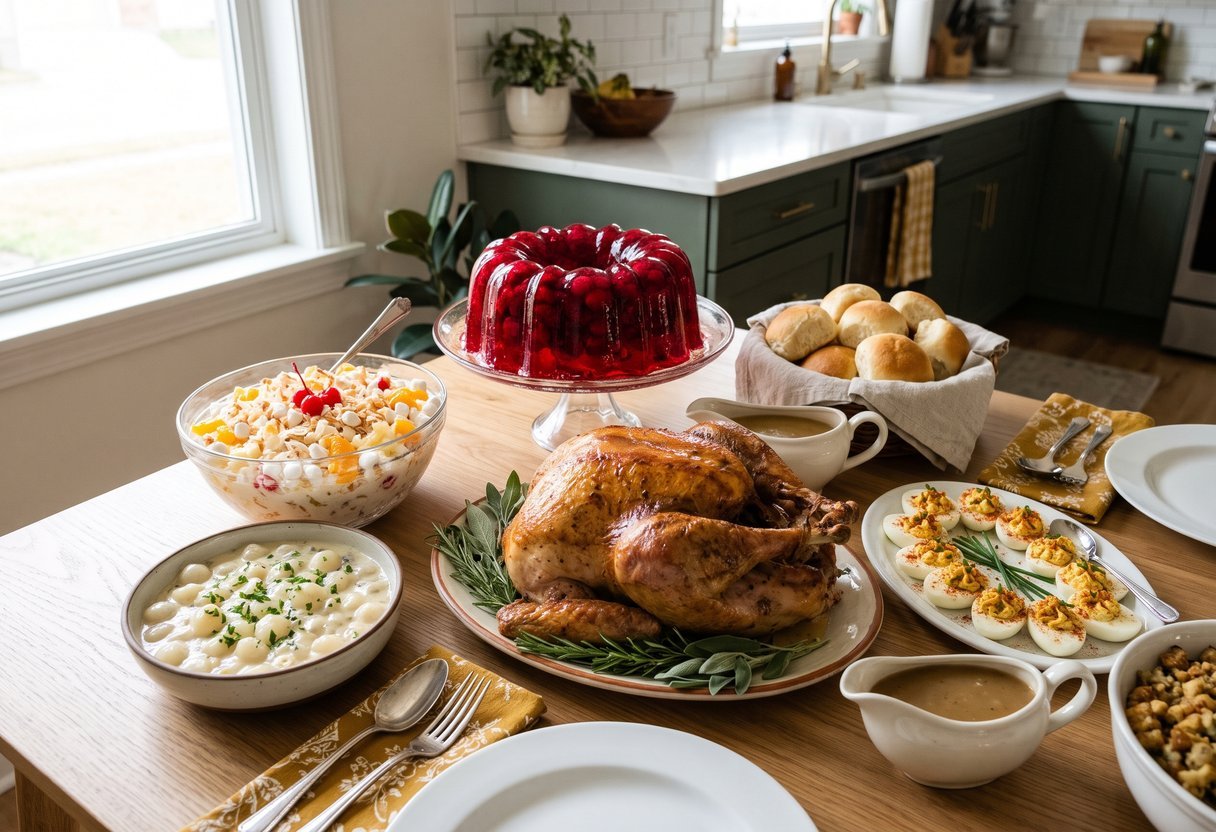
At Thanksgiving, an old family photo lands beside the turkey, and someone points to an unfamiliar dish at the edge of the table. Guessing from the picture alone falls short because it cannot show what the dish contained or why it belonged at dinner. The recipes behind that spread offer a clearer look at how different a 1970s Thanksgiving table could be.
Eight dishes show how Thanksgiving tables have changed
Ambrosia salad, Jell-O salad, creamed onions, oyster stuffing, mincemeat pie, tomato aspic, Watergate salad, and deviled eggs are 8 dishes associated with older Thanksgiving spreads. Together, they show how regional traditions, molded salads, and sweet side dishes once shared space with turkey and pie.
They were never on every American table, and some remain holiday favorites in particular families. Still, ambrosia and Jell-O salads have largely fallen out of favor, while several of the others are less familiar to Thanksgiving guests today.
Sweet salads brought fruit and convenience to the table
Ambrosia salad has a longer history than its association with 1970s holidays suggests. An 1867 recipe by North Carolina cookbook author Maria Massey Barringer called for grated coconut, sugar, and fruit pulp. Fresh winter oranges and coconuts may help explain its place in Southern celebrations; its sweetness may be less appealing to households that prefer fruit without a sugary dressing.
Jell-O salads offered a different kind of novelty: fruit or vegetables suspended in a colorful gelatin mold. Their popularity was already waning by the mid-1970s, with changing dieting fashions among the reasons cited. Unlike a bowl of cut fruit, a mold holds its shape because the gelatin sets the liquid, but that firm texture is also part of what makes it a less familiar side dish today.
Watergate salad paired pistachio pudding, crushed pineapple, nuts, and whipped topping. First published in the early 1970s, it acquired a name associated with the Watergate era, though the dish had no connection to the scandal. Its pudding-and-topping base makes it a dessert-like addition to a savory meal rather than a substitute for a vegetable side.
Regional sides and molded dishes had distinct appeal
Creamed onions, especially pearl onions in a rich sauce, are a New England holiday tradition whose popularity peaked before the 1970s. The sauce coats the small onions and gives the dish its characteristic richness. It is still worth considering for a family that enjoys it, but it is not a dairy-free side without changing the recipe.
Oyster stuffing or dressing has roots in British colonial cooking, when oysters were plentiful in America. Its long holiday history includes a place on the White House Thanksgiving menu beginning in 1897 and continuing through 2016. The oysters lend a briny flavor that ordinary bread stuffing does not provide; households that do not enjoy shellfish can choose a different dressing.
Tomato aspic was another molded dish, made with tomato juice, gelatin, and seasonings such as lemon juice and Worcestershire sauce. It rose to prominence in the 1950s, when congealed dishes were common on holiday tables. Its firm texture and savory tomato flavor set it apart from the fresh salads more familiar at many meals now.
Older appetizers and desserts can still fit a menu
Mincemeat pie once held a more prominent place among Thanksgiving desserts. Although it historically contained meat, many modern versions instead use dried fruit, spices, and spirits, so the name alone does not describe what is in the filling. Anyone serving it should check the recipe or label rather than assume it is meat-free or alcohol-free.
Deviled eggs were familiar on 1960s and 1970s buffet-style relish trays, often with mayonnaise, mustard, and paprika in the yolk filling. They have not disappeared, but an egg-and-mayonnaise appetizer needs more care on a buffet than a shelf-stable snack. For a practical nod to an older Thanksgiving spread, serve a small platter and keep the rest refrigerated until needed.